
Employee Benefits Captive Insurance
Take control of your health plan costs
Tribute captive, our employee benefits group captive, provides a structured approach to managing your health plan. It offers greater visibility into performance, more consistency in costs over time, and resources that support employee engagement and informed health care decisions.
See if Tribute is right for you:
- Submit Your Information Online
- We Connect to Understand Your Needs
- We Offer a Customized Captive Solution
- You Move Forward With Confidence

What our members say
-
I wanted to take a moment to sincerely thank you for arranging the direct billing agreement with a facility. One of our employees was facing a serious battle with addiction and severe depression and urgently needed inpatient care. Thanks to your compassion and quick action, they were able to get the help they needed.
I’m happy to share that they are doing incredibly well now—full of energy and optimism. I check in with them weekly, and the progress the employee's made has been nothing short of inspiring. In fact, they were recently promoted to a management role.
Your support made a real difference, and I’m so grateful for it.
J
Joey Richman, SHRM-CP
Human Resources Manager, General Distributing Co.

Did you know?
Leavitt Great West’s Tribute captive is one of only 13 captives worldwide to have obtained Berkley Accident and Health’s Risk Management Certification.
What is a captive?
A captive is a medium for taking risk.
It can be formed by a single company (a single-parent captive), or by multiple companies (a group captive).
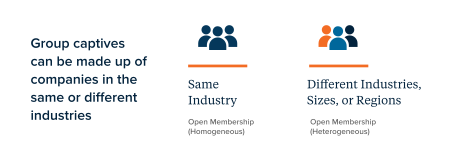
Group captives can be made up of companies in the same industry or different industries, and allow small employers to act like large employers.
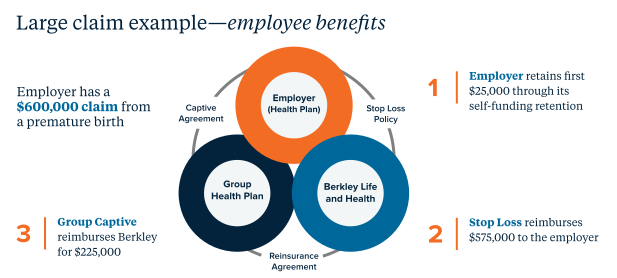
A medical stop-loss captive is a form of self-insurance where multiple employers come together to collectively fund their employee benefit programs.
By pooling resources, companies can gain more control over their benefit costs, customize plans to meet their specific needs, and potentially save money in the long run. This approach allows for greater flexibility and stability in managing employee benefits.
How does a group captive work?
Imagine a shared bank account, where everyone puts money in and then some is taken out when a claim occurs. In good years, members will receive any unused funds back from the captive. In bad years, members will not receive funds back, but they know their costs will be capped at a maximum liability amount.
With Tribute, employers also gain ongoing visibility into claims activity and plan performance, helping them make more informed decisions throughout the year
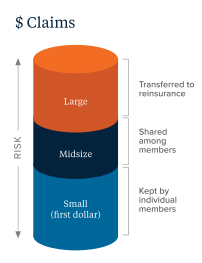
Risk is retained, shared, or transferred, depending on how unpredictable and costly it is.
- Largest risks are transferred to the stop-loss insurer.
- Medium risks are shared with other employers.
- Smallest risks are retained (kept) by the employer.
Why join a captive?

Benefits of Employee Benefit Group Captives
- Short-term savings
- Long-term savings
- Enhanced control
- Limited volatility
- Group power
- Increased employee productivity
Leavitt Group also offers group captive options for property and casualty programs.
A more connected approach to managing employee health
With Tribute, employers are part of a group that shares insight, performance data, and strategies—creating a more informed and stable approach to managing employee benefits over time.
By pooling resources, organizations gain more control over benefit costs, the flexibility to design plans around their workforce, and the opportunity to participate in strong plan performance over time.
Is a Leavitt Group captive right for you?
If your company has robust loss control, a great safety culture, and secure finances, you may benefit from a captive insurance policy.
Ideal Captive Candidates
- Privately held
- 50+ eligible employees enrolled
- Currently self-funded or willing to implement upon inception
- Financially secure
- Desire to manage risk
- High accountability
Our Clients
- Receive lower average stop-loss renewal increases
- Experience more stable renewal actions
- Can receive a portion of their stop-loss premium back

Tribute captive highlights
- Over $12.8M in savings for participating employers
- Recognized for excellence in health risk management
- Awarded risk management certification from Berkley Accident and Health in 2023 and 2024 (one of only 13 captives worldwide)
What captive coverage options do I have?
Captive programs like Tribute support a range of employee benefits strategies designed to align your health plan with your workforce and long-term cost goals.
- Employee health plans
- Pharmacy programs
- Stop-loss coverage
- Ancillary benefits such as dental, vision, life, and disability
- Other customized solutions, depending on program structure
Tribute also provides flexibility in how your plan is structured, along with ongoing visibility into performance, supporting more informed decisions throughout the year.
Cost comparison:
traditional insurance vs. group captive
Traditional Insurance
You get coverage, but any unused premium profits do NOT go back to you.
In traditional insurance, you pay a premium to your insurance company for coverage. Most of that premium goes towards operating costs, which may include shareholder distribution, brick and mortar locations, commercials, CEO, front insurance, and re-insurance. The remainder is invested and returned to the insurance carrier.
The rest of the premium goes towards paying claims. There is little risk to you because the insurance company is paying those claims. However, you have little to no control of claim decisions, and no ability to receive underwriting profit or investment income.
Group Captive
You get coverage, and any unused premium and investment income comes back to your business.
Captive insurance allows you (the insured) to own an insurance company with like-minded companies and bring the underwriting profit and investment income back to your company. There are still operating costs, which may include front insurance, re-insurance, loss control, and claims administration, but the cost to cover these is often lower than in traditional insurance.
You have control of your insurance, stabilization and suppression of premiums, company ownership with the creation of a profit center, operational transparency, return of underwriting profit and investment income back to members, choice of legal representation, and ultimate control on claims. However – there is both risk and reward, as claims will be paid out of your premium.
Did you know?
- 82% of American workers are covered by a self-funded employer health plan
- 90% of Fortune 500 companies participate in at least one captive insurance program
Learn more
Your captive insurance team
Contact us with any questions. Call: (877) 229-4553







Frequently Asked Questions
-
What is a captive (captive insurance)?
A captive is an insurance option used for managing risk, typically owned by the insured(s). It can be structured as:
- Single parent captive: owned by a single company
- Group captive: formed by multiple companies, often enabling small employers to operate like large ones
-
What is a group captive and how does it work?
A group captive functions like a pooled bank account: members contribute premium funds and the account pays for claims.
- In good years, unused funds may be returned to members.
- In challenging years, there's no return, but liability is limited by a maximum amount.
- Risk is tiered: large risks are transferred to a stop-loss insurer, medium risks are shared among members, and small risks are retained by employers.
-
Why should my company consider joining a captive?
Captives can offer:
- Short‑ and long‑term savings
- More control over your insurance program
- More stable and predictable premiums
- Group leverage
- Increased employee productivity
These benefits apply to both employee benefit group captives and property & casualty captives.
-
What makes a company an ideal captive candidate?
Companies that fit well:
- Are privately held
- Have 50+ eligible employees enrolled
- Are already self‑funded or willing to implement it
- Are financially secure
- Have a strong safety culture and effective loss control
- Maintain high accountability
-
What kind of results can members expect?
Clients often experience:
- Smaller and more predictable increases at renewal
- Renewals that are less disruptive year to year
- The chance to get money back from a portion of their stop-loss premium
-
How does captive insurance compare to traditional insurance?
- Traditional insurance: You pay premiums, the carrier absorbs the risk, and any unused premiums don’t return to you.
- Group captive: You effectively own a piece of the insurance alongside others. Unused premiums and investment income can be returned to members. Operational costs are often lower, and you gain underwriting control, transparency, and potential profit returns. However, you assume more risk as claims are paid from your own premium pool.
-
What coverage options are available through captive insurance?
Captives can include most standard policy types, such as:
- Commercial Auto
- Cyber Security & Terrorism
- Employee Healthcare
- Extended Warranty & Service Contracts
- General Liability
- Product Liability
- Professional Liability
- Workers Compensation
They can also offer highly specialized coverage (e.g., credit risk or asbestos-related issues). If you can imagine it, they can create it.